The AI-Era Sales Playbook
How five scaled companies built their top-down sales machines
· 19 min read
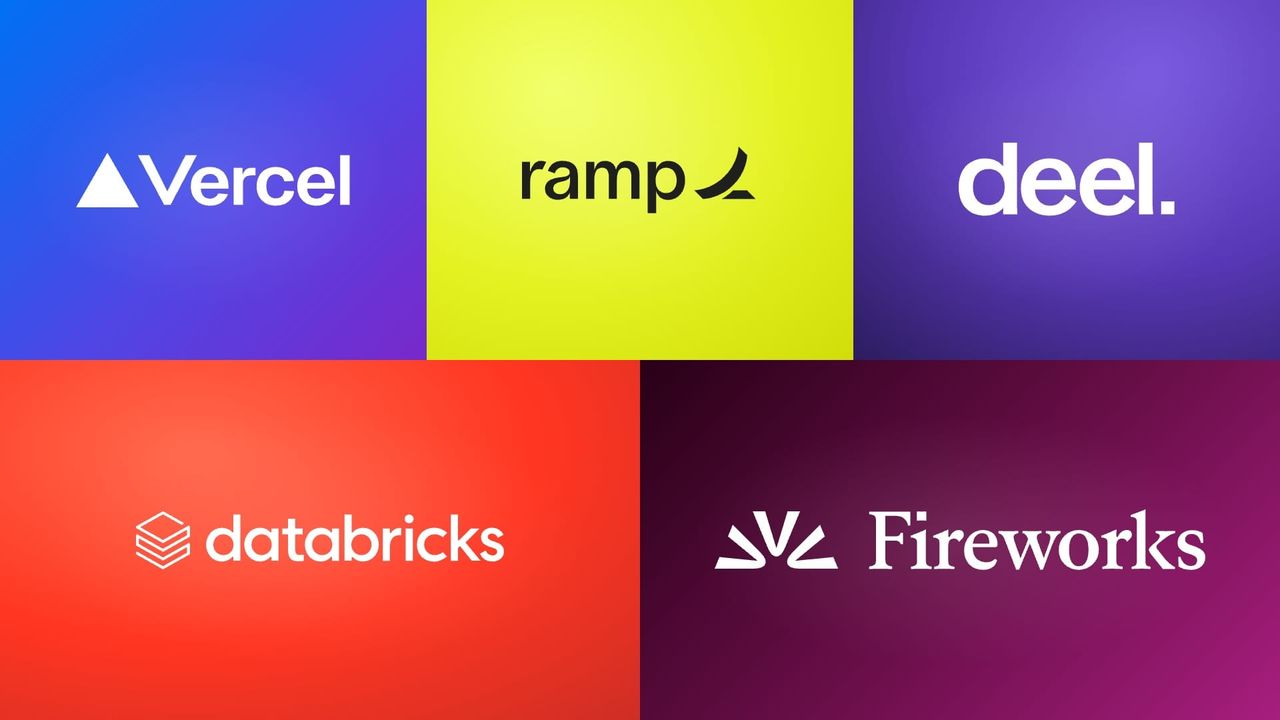
Ramp crossed $1 billion in annualized revenue five years after launching its first corporate card. Vercel's run rate is north of $600 million, growing 150% YoY. Deel went from $100 million to $1 billion in ARR in three years. Databricks built a sales engine that grew from $1 million to $7 billion in ARR.
Sales used to scale one way: hire more reps, carry more quota. Those rules no longer apply. For example, Vercel cut its inbound sales development team from 10 people to 1 and raised quotas every six months. Ramp turned 30 minutes of pre-call research into 90 seconds.
All five companies here sell top-down. Each has passed $100 million in annual revenue. Put them side by side and one operating philosophy comes through. Prove how customers buy. Make the work repeatable. Use AI to increase capacity. Expand where you can win.
The five companies:
- Ramp sells corporate cards and spend software to finance teams, with ~500 people in sales.
- Vercel is a developer platform. Developers adopt it bottoms-up, and a sales team led by COO Jeanne DeWitt Grosser sells it to their companies.
- Deel sells global payroll and HR in more than 150 countries with a remote sales team.
- Databricks sells a data and AI platform to large enterprises, after an early bet that it could grow without salespeople.
- Fireworks sells AI inference to fast-growing AI companies. Bardia Shahali ran its sales as revenue grew from $3 million to $400 million, and now runs sales at Granola.
This playbook breaks down 13 rules for top-down sales in the AI era. We describe whether it is a pattern across several of these companies or a practice seen at one. (For the basics of building an inside sales team, like hiring proofs, setting commissions and when to cut a rep, see The Inside Sales Playbook).
tl;dr: sell the first customers yourself; post-PMF, aggressively invest in distribution; hire a sales leader who has built the machine before; and teach your agents what your best rep does.
Inside you will find:
Part 1. Prove how customers buy
- Sell your first customers yourself. See how Deel's founders onboarded nearly 100 clients themselves before hiring a single seller.
- Fix the buying obstacle before you add sellers. Find out what 10 enterprise conversations told Vercel's COO that the sales team couldn't.
- Once you have PMF, spend aggressively on distribution. Learn why Databricks dropped its zero-touch experiment after revenue flatlined.
Part 2. Make the work repeatable
- Hire a sales leader who can build the machine. See the three tests behind the CRO who took Databricks from $1 million to $7 billion in ARR.
- Hire for the demand you actually have. Learn the four buckets Ramp splits every seller's number into, and the profile Databricks hires for instead of PhDs.
- Build the funnel math before you commit to the number. See how a model built in the first few weeks showed Vercel a third-quarter gap in time to fix it.
- Design the incentive system so sellers sell what you need. Find out why Databricks ends sales arguments with the comp plan.
- Test the champion before you commit. Learn the one request that tells a Ramp seller whether a deal is real.
Part 3. Use AI to increase capacity
- Learn the workflow from your best rep before you automate it. See how one week of shadowing turned 10 inbound reps into 1.
- Prove the extra capacity, then raise the quota. Find out why enterprise quotas went from $1.5 million to $4 million with similar pay.
- Retire a channel when anyone can buy it. Learn why Ramp shut down the automation that brought in about 30% of its pipeline.
Part 4. Expand where you can win
- Go wide early, then specialize where generic stops winning. See how Deel sold worldwide from day one, and when Ramp and Vercel split their teams.
- Take on the leader where it is weak. Learn the three weaknesses Databricks used to take on Snowflake, one account at a time.
Part 1. Prove how customers buy
Rule 1. Sell your first customers yourself
Pattern across Deel and Ramp
Before Deel built a sales team, its founders did the selling. They talked to 200 founders about how they hire people abroad, then onboarded nearly 100 clients themselves. By the time Deel hired sellers, it knew who bought, why and what they asked for.
The habit never stopped. Deel's co-founder and CRO, Shuo Wang, has one hot take, repeated whenever asked: founders need to sell more. Wang pitches whoever is at the dinner table, then follows up afterward.
Ramp's founders stayed just as close. Max Freeman joined as an SDR four or five months into the company, and for the first nine months CEO Eric Glyman was effectively Freeman's boss. Selling started almost as soon as the product did, with the founders inside every lesson about who buys a corporate card and why.
The point is what the founder learns. The first customers show who has the authority to buy, what makes them say yes and where the product falls short. A sales team hired later inherits those answers instead of guessing.
Use it when: you have a product someone can buy, and before you have written a job description for your first seller.
Why it works: the founder hears every objection firsthand, so the first sales hire gets a proven pitch and a known buyer instead of a blank page.
Our read: count the customers you closed yourself before you hire anyone to close more. Deel's number was close to 100.
Spotted an error? Email signal@signalful.com and we’ll fix it.