Bill Perkins: Set a Date to Stop Getting Richer
Bill Perkins once swung from $100 million to $250 million in a year as a trader. At 57, he says your net worth should peak on a date you pick.
· 8 min read
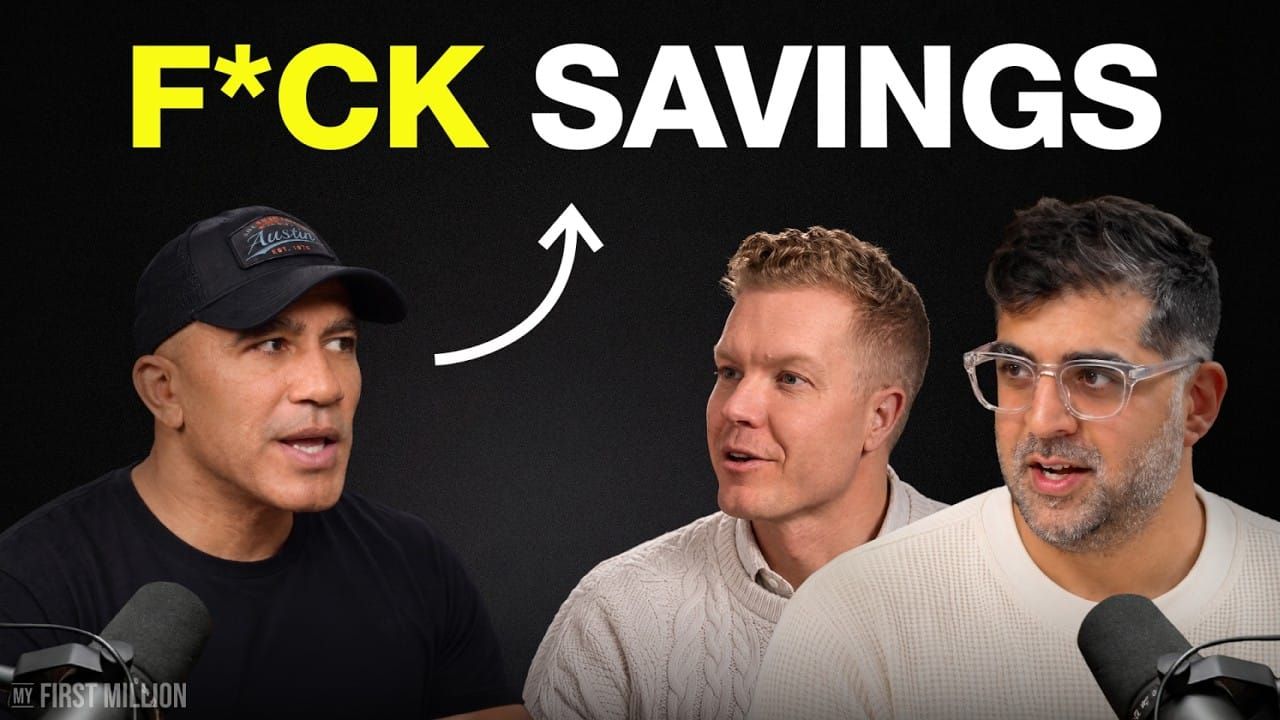
Bill Perkins, energy trader and author of Die with Zero · My First Million
Bill Perkins made his fortune trading natural gas derivatives. He started as a clerk on the New York Mercantile Exchange floor, became an over-the-counter broker, and moved to Houston to trade after deregulation in 1995. He still runs a hedge fund built for concentrated bets. He wrote Die with Zero, a book about spending money, health and time while they can still buy fulfillment. At 57, he also runs 2 startups, including SkyFi, which lets anyone order a satellite image from a phone.
Summary
Bill Perkins argues that money matters only as the fulfillment you convert it into, and your body's ability to do that conversion declines with age, so your net worth should peak on a date you choose. The same trader who says young people should concentrate risk and bet the farm now refuses to spend his current years earning capital for an older self who can't use it. Experiences belong to specific 3 to 5 year time buckets, and an inheritance, a ski trip or a fitness goal loses value when pushed late. The biggest obstacle is ego: most people avoid the life they want because they can't take the status drop, when the fear that should rule is the fear of a wasted life. These signals are from an interview that Shaan Puri and Sam Parr did with Bill Perkins on My First Million.
- Traders as Insurers. Energy traders make money by selling insurance to people who need it, and they rarely compete head-on with other smart traders. Bill Perkins trades only when the market price drifts far enough from his estimate of fair value, then charges for the risk the way an insurance agent prices a policy. Most of his money came from being short natural gas: buyers feared winter price spikes and paid to lock in hedges, and the winter risk premium usually bled out as prices fell. ▶ 2:19
Quote: “We're really not in competition with the other smart guys. Like we're kind of glorified insurance agents.” (▶ 2:22) - Maximum Risk When Young. Young people should concentrate their bets, because they can always get another job. As a young trader, Perkins kept most of his money out of the fund he traded, following a rule that a job with no money or money with no job was fine, but never neither. He now calls that rule absolutely wrong. Had he kept his money in the fund, he would have made a lot more of it. ▶ 3:41
Quote: “I was very young and maximizing risk at that age is probably the way to go.” (▶ 4:12) - Temperament Over Knowledge. Superior knowledge of supply and demand is worthless without the temperament to absorb losses. Perkins's edge combined information with temperament, and arbitrage played no part. A trader who isn't stoic about losses can't think clearly while the amygdala is going crazy, and anyone who needs 5 wins for every loss will fail, because trading never offers that ratio. The information edge itself comes from obsession: with a position on, a trader is always working and never off. ▶ 6:21
- Stay in the Game. A fund built to get rich must survive its worst years. Perkins runs his for concentration, so investors can lose 100% or make 300%, and the case for it rests on the expected outcome. His own swings have run from down 50% to up 250%, taking the fund from about $100 million to $250 million in a year. In a market that pays people who study it and keep their wits, anyone who avoids blowing up eventually earns outsized returns. Insurers show the pattern: 2 hurricanes nearly wipe them out, they keep writing policies at higher prices, and then they print money. ▶ 8:09
Quote: “The name of the game is to stay in the game.” (▶ 9:29) - The Equities Fee Machine. Perkins would pick equities over commodities if he started again, because the money is much bigger. Equities draw far more capital and enjoy positive drift from the stock market, and managers run $6 billion or $10 billion funds on track records he considers merely okay. A $6 billion fund charging 1% to 1.5% turns its management fee into a profit center before any upside, and the notional dollars make that upside enormous. ▶ 11:27
- Net Worth Peak by Date. Your net worth should peak on a date, chosen before your ability to enjoy money fades. Perkins set a goal of being a millionaire before 30 and blew through it, then realized the goal was a cookie-cutter answer he had never thought through. The body is a decaying asset: its ability to convert money into fulfillment declines, the slope picks up somewhere between 30 and 65, and near the deathbed more money means nothing. He still works because yachting and private travel buy him fulfillment, and he would quit in a heartbeat once an extra dollar added none. ▶ 14:15
Quote: “I'm 57. I'm not here trying to have a party at 85.” (▶ 12:36) - Fear of a Wasted Life. Perkins fears wasting his life far more than losing money, status or what he has built. Most people get so caught up in making money that they guard the wrong asset, and money is only a tool. Every regret he has is a version of not doing his best, from losing his temper to getting fat and out of shape. Bad things still happen to him, and he doesn't regret the ones he gave his best to. ▶ 19:36
Quote: “I was very very afraid of wasting my life. Very very afraid.” (▶ 19:38) - Ego Risk. Most people who never start a business or chase an opportunity hold back because their ego can't take the status drop. They could handle the money risk, including losing a job and waiting tables. What stops them is falling behind friends on the money-making pole and looking like a fool, and they cover it with motivated reasoning about why the move was too hard. People also quietly root for you to fail, because your attempt exposes their own cowardice. Perkins crushes his own ego as a constant practice, which includes training himself to ignore what others think, in compliments and in derision. ▶ 20:38
Quote: “They cannot take the ego risk. They can't take the judgment of their own selves, their parents, their friends, wider society that they went out, tried this thing and failed.” (▶ 21:49) - Programmed Desires. Most of what people think they want is cultural programming, and the job is to find which parts fit. Perkins realized many of his wants were great marketing from society and the movies: he finds fried crickets repulsive only because he didn't grow up in Asia. A University of Iowa football teammate who rejected the white-picket-fence life haunted him for years, because Perkins couldn't even picture an alternative. He kept the programming that worked and replaced the rest, judging each habitual response, to an insult or to being cheated, by one test: does it work for my goals. Undoing 20-some years of programming took years. ▶ 26:13
Quote: “Almost all the things that I liked were programming, not innate.” (▶ 26:53) - Time Buckets. Plan life in 3 to 5 year time buckets instead of a bucket list saved for the end. Each stage of life dies in turn (the college you, the single you, the you with young kids), and experiences that fit one stage transfer poorly or not at all to the next. Someone who wants to ski 500 times needs most of those trips early, especially the ones with friends who will later marry and have kids. Perkins compares life to Tetris: get the order right to get the high score. Balance works across periods too, swinging from grinding to vacationing to spiritual work, and he and his wife plan to live in Japan while their son is under 5. ▶ 34:43
Anecdote: Perkins put off backpacking in his 20s, and when he finally went in his 30s, already a millionaire, sleeping on trains no longer suited him. He was too bougie by then to enjoy what would have thrilled him a decade earlier. (Bill Perkins, ▶ 51:06) - The Centurion Olympics. Perkins's biggest current failure is health, and he measures it against what he wants to do in his last decade. Four years ago he had 8% body fat and VO2 max in the top 1%. Now he sits around 16% to 18% body fat with VO2 max near the middle for his age, which he calls pretty horrible given that the US average includes a 40% obesity rate. His doctor's Centurion Olympics has him pick 10 activities for his final decade, such as wake surfing, and projects his decline: on his current trajectory he can't do 80% of them. He has hired a trainer and is evaluating one who would travel with him, since travel is always his excuse. ▶ 38:42
Quote: “If I can't be accountable, I need to outsource accountability.” (▶ 42:10) - Living Inheritance. Waiting until death to pass on an inheritance makes no sense when the heirs are often 60 by then. That is the change readers of Die with Zero make most often, especially older readers with discretionary income who now take estate planning seriously. Others have moved their retirement dates, or retired their own parents so their only job is to spend time with the grandchildren. ▶ 46:47
Anecdote: A reader in the military wrote that his guaranteed lifetime pension made his growing pile of savings pointless, and he started spending it on living. (Bill Perkins, ▶ 48:20) - Three Tools. Wealth is only 1 of 3 tools for a fulfilling life, along with health and time. Perkins took his definition of money from the book Your Money or Your Life: money is what you exchange hours of your life for, which forces the question of what each hour buys. Many of the best choices cost nothing, such as seeing your mother, playing cards with friends or driving your kids to school without complaining. Readers who apply the idea look at all 3 variables and ask which tool they are using badly. ▶ 48:46
Quote: “It wasn't a money decision. It was a how do I allocate my time decision.” (▶ 49:33) - The Collector's Arbitrage. Collectors decide what future generations see, and old bias leaves important work underpriced. Museums show what earlier wealthy patrons chose to preserve, which statistically isn't the best art, since much of the rest burned or never left private houses. Museums long refused to collect African-American art, and the stigma about who should own it still holds prices down, even within the Black community. Perkins paid $15 million for Ernie Barnes's Sugar Shack, a painting of Black joy in the segregated South that appeared on a Marvin Gaye album and in the credits of Good Times, after planning to pay $3 million to $5 million. The sale reset the market: another Barnes he might have bought for a couple hundred thousand dollars went for about $2 million. He doesn't expect the gap to close in his lifetime. ▶ 1:07:30
Anecdote: In the middle of the bidding, the art consultant bidding against Perkins turned around and told him he would not stop, and Perkins answered that he would make him pay. Before the auction he had told his wife to keep bidding if he fainted. (Bill Perkins, ▶ 1:06:23) - The Fame Trap. Fame robs you of the life money is supposed to buy. Perkins chased fame as marketing during a hedonistic stretch after his divorce, then watched friends like Michael Phelps and Dan Bilzerian fail to walk the shops in Capri without interruption. A famous person also becomes a slave to a persona: the nice guy must always be nice, and the action star always aggressive. Perkins wrote Die with Zero to have a fulfilling life, so he left the handbooks and software to others and told a fan who wanted to start a Die with Zero podcast to have at it. ▶ 1:15:46
Quote: “Fame shrinks your world and you go into a bubble.” (▶ 1:15:59)
Watch the full video at https://www.youtube.com/watch?v=OE32mgQCN6E.
Spotted an error? Email signal@signalful.com and we’ll fix it.