Why Bill Ackman Expects a Venture Blowup
Bill Ackman says a high-profile blowup is coming in venture and that some of today's most dominant companies will disappear. His advice to founders: raise now, spend like it's your own money.
· 7 min read
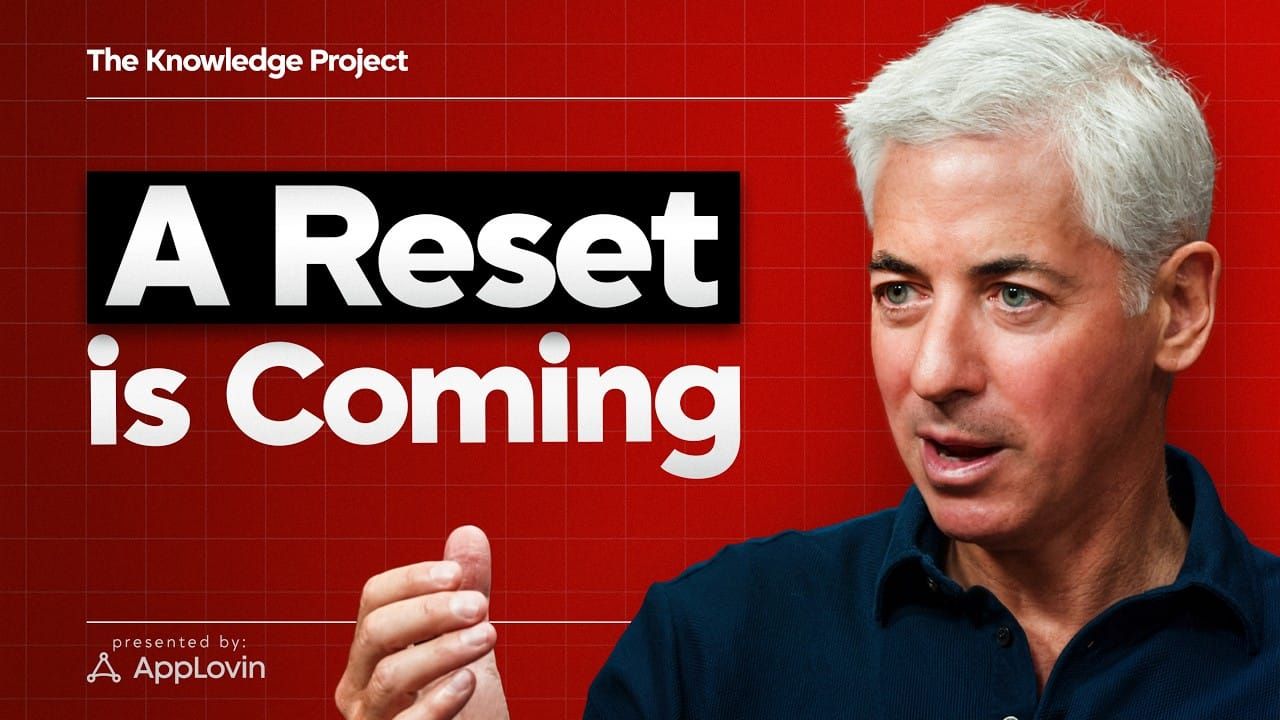
Bill Ackman, founder and CEO of Pershing Square, interviewed by Shane Parrish (The Knowledge Project Podcast)
Bill Ackman is the founder and CEO of Pershing Square Capital Management, a New York investment firm he started in 2004 that runs several public vehicles, including Pershing Square Holdings, Pershing Square USA and a controlling stake in Howard Hughes Holdings. He made his name with activist campaigns at companies such as General Growth Properties and Chipotle, and with a credit default swap bet that paid off in the 2020 COVID crash. He turned 60 this year. His daughter Lucy survived a brain hemorrhage in 2026, and he is now building a brain recovery institute in Manhattan.
Summary
Bill Ackman says AI raises the risk of disruption for every business, and that even companies that look dominant today may disappear. He expects venture capital to hit a high-profile blowup, and tells founders to raise money now but spend it as if it were their own. Pershing Square owns only highly predictable companies, keeps its team stable for years, and does not use AI to build models. Ackman is also copying Buffett's playbook at Howard Hughes, where an insurer, permanent capital and a 47% stake are meant to let him think in decades. These signals are from an interview that Shane Parrish did with Bill Ackman on The Knowledge Project Podcast.
- Rehab Has No Payer. Bill Ackman says brain injury care breaks down after the surgery, because nobody is paid to follow the patient's recovery. Neurosurgeons are highly compensated for operating, many hospital rehab programs are "embarrassingly inadequate," and an insurer might pay for only 6 weeks of care. The head of rehab at Mass General told him the typical surgical patient ends up in a nursing home and dies a few months later from pneumonia. Ackman thinks technology can fill the gap, starting with AI as a speech therapist where a human one can cost $500 an hour. The institute he is building focuses on brain rehab, recovery and longevity, and he wants everyone to get the benefit. He also plans real food for patients, since he calls hospital meals frightening. ▶ 13:10
- Zero Turnover. Pershing Square's investment team has stayed the same for 9 years, apart from a few additions. Ackman says that in an industry where top people move for $100 million bonuses, a revolving door leaves you unsure whether anyone is telling you every risk. After 9 years of candor, he doesn't question anything the team tells him, and he now generates only a minority of the portfolio's ideas. That frees him to work on strategy. ▶ 17:48
- FOMO Pricing. Ackman sees bubble-like behavior in venture. A company he met that wasn't raising was preempted two days later by an investor who put in $50 million at a $400 million valuation, and two weeks after that it raised $50 million more at $1 billion. He also saw a Series A at a $5 billion pre-money. He describes a bubble as more and more money chasing one trade out of fear of missing out, until valuations overshoot. Berkshire stock hit an all-time low in the internet bubble because Buffett sat out the boom, and Ackman says staying out depends on whether you think short-term or long-term. ▶ 24:44
- Raise Now, Spend Carefully. Ackman calls this a great time to raise capital and tells founders not to spend it as if the money will be there forever. In the internet bubble, a weekend Barron's piece listed every public internet company's cash and its months left before zero, probably the week before the market blew up. He expects another high-profile blowup where people lose a lot of money and the market resets. Companies with years of runway will survive, and the ones that must raise in 3 months will be gone. His advice is to treat every dollar as your own. ▶ 27:01
- Bet on the Person. In venture, Ackman weights the founder over the idea, because the original idea is often not the one that works. His best venture investment was Coupang. Bom Kim pitched the Groupon of South Korea in 2009, and Ackman thought Groupon was a bad model, but he liked Kim and his case for South Korea as a launch market. Kim built the Amazon of South Korea, which had little to do with the plan. In public markets a bad CEO can be replaced, and Ackman says the best private companies without their founder are close to a write-off. ▶ 28:33
- Disruption Is the Risk. Ackman says an investor's most important job is assessing risk, and AI has massively increased the risk of disruption. Buffett could not see the internet coming for businesses like World Book, and Ackman says every investor is now guaranteed to look foolish on at least one business. His discipline is to predict what a company looks like 10, 20 and 30 years out, and to buy only what he'd happily own if the stock market closed for 10 years. ▶ 30:07
- Updates in Days. The pace of AI improvement is the fastest Ackman has ever seen. Microsoft's old 1.0 to 2.0 updates took a couple of years or more, and now a consequential update arrives in days, like a Tesla updating its software overnight. He says "scare" is probably the wrong word, and he wants investors to be thoughtful about how wide a moat really is. Ackman calls predicting disruption the most complicated question an investor faces, and he expects some of the most dominant-looking businesses in the world to disappear. ▶ 33:11
- The Library of Companies. Pershing Square holds a library of great businesses it has followed for years but couldn't buy. At 35 times earnings, for example, it is hard to reach the 20%-plus return the firm wants, so the team does the work and sets the name aside. It waits for a macro event to reprice the business. COVID gave it chances, and the "SaaS apocalypse" let it buy Microsoft at what Ackman calls a very attractive valuation, along with other high-quality businesses. ▶ 35:30
- The Fresh-Eyes Panel. Two team members do each deep dive, starting with 10-Ks, 10-Qs and call transcripts and moving to expert networks of former employees, industry experts and competitors. They build a model of the return at today's price and present a deck. Ackman and CIO Ryan are usually not the two, but they run an independent assessment that gives them "enough information to be dangerous" to ask the right questions. The other five team members, who haven't done the work on that name, challenge the deck, and the meeting ends in a decision or a list of open issues to chase. ▶ 36:17
- Do What Nobody Has Done. Pershing Square uses AI as a research tool and doesn't use it to build models. Ackman says that when everyone has the same access to AI it is hard to be differentiated, and what's left is outside-the-box thinking, because AI reviews everything that already happened. His best investments were things nobody had done: credit default swaps before the pandemic, the stock of a bankrupt company, and shorting AAA credit before the financial crisis. AI would not have told him to do any of them. The same logic made money going into COVID, when the firm was weeks ahead of the world on a global shutdown, and again when it bet that rates would rise on inflation. He says an asymmetric bet, a view different from everyone else's expressed through an instrument that pays far more than the capital at risk, is how you make a lot of money. ▶ 37:48
- The Stone Tablet. After a very large loss around 2015 and 2016, Ackman had the firm's investment principles engraved on a stone tablet and put it on his desk. The checklist asks for simple, predictable, free-cash-flow-generative companies, large and liquid, run by a strong management team or one with a named replacement ready. It also lists an aversion to short selling and a requirement that asymmetric bets pay far more than the capital at work. Ackman says a checklist is a good way to avoid mistakes. ▶ 39:21
- Asymmetry in Reverse. Ackman never liked short selling, because you can lose infinity and the most you can make is finite. Pershing Square still shorted a company it saw as a fraudulent pyramid scheme, planned to hand the FTC a detailed analysis, and felt the wind was at its back. It underestimated market dynamics when Carl Icahn bought the stock against it, and the trade turned into a hedge fund squeeze on Ackman. Shorting also costs friends: Pershing held the vast majority of the short interest, so everyone else sat on the other side, and the company had built infrastructure to attack its critics. ▶ 40:54
- Sell When the Thesis Breaks. Pershing Square bought a meaningful Netflix stake after a subscriber miss and shared its deck with management, who agreed with the thesis and said they would never run ads. A few weeks later Netflix missed subscribers again and said it would launch an advertising model. Ackman's rule is that new information inconsistent with the thesis means you either buy a lot more because the news is immaterial or you exit because the thesis is broken. He exited, because a firm that owns only the highest-certainty companies couldn't accept a much wider range of outcomes, and moved the money into Alphabet. Netflix then executed well and its stock went back to a high multiple. When the stock was later cut in half, Pershing bought it back at a price it liked. ▶ 50:55
- A Modern Berkshire. Ackman owns 47% of Howard Hughes and is turning it from a real estate company into an insurance holding company. Pershing Square bought the specialty insurer Vantage Holdings and recruited what Ackman calls the best management team in insurance. The model is Buffett's: hold the float in short-term treasuries to pay claims, put the rest in common stocks, and earn a profit on both underwriting and assets. With liabilities that carry a negative cost, Ackman says an insurer can generate a 20% or higher annual return. Howard Hughes is about 70% real estate and 30% insurance by capital today, and he expects 70% to 75% insurance within 5 years, funded by real estate that throws off close to $300 million of net operating income. Wall Street has wanted nothing to do with the business for 14 years, so the stock still trades at a discount to its assets. ▶ 58:35
- Never Forced by Circumstances. Asked about Charlie Munger's remark that Berkshire was almost never forced to make decisions by circumstances, so it always had options, Ackman says Pershing Square designed its business around that. The firm holds anchor stakes in each public vehicle it runs, with employees owning 28% of Pershing Square Holdings and investing more than $500 million in Pershing Square USA. If the market panics and people want liquidity, they can sell the stock while the capital stays in the vehicle, which let the firm buy in the COVID crash and the financial crisis. Ackman says allocators pull money when a fund does well because it gets too big a share of their portfolio, and pull it when it does badly. He traces his biggest investment mistake to being distracted by raising capital for open-ended funds. If the firm compounds at anything close to its historic rate, he says it will manage a trillion dollars in 20 years. ▶ 64:40
Watch the full video at https://www.youtube.com/watch?v=Cpq8y5HpcF4.