How Uber's Agents Write 15% of Production PRs
About 15% of Uber's production PRs now come from its background coding agent. An Uber engineer says the harness is the easy part: the platform built over 10 years is what makes agents work.
· 8 min read
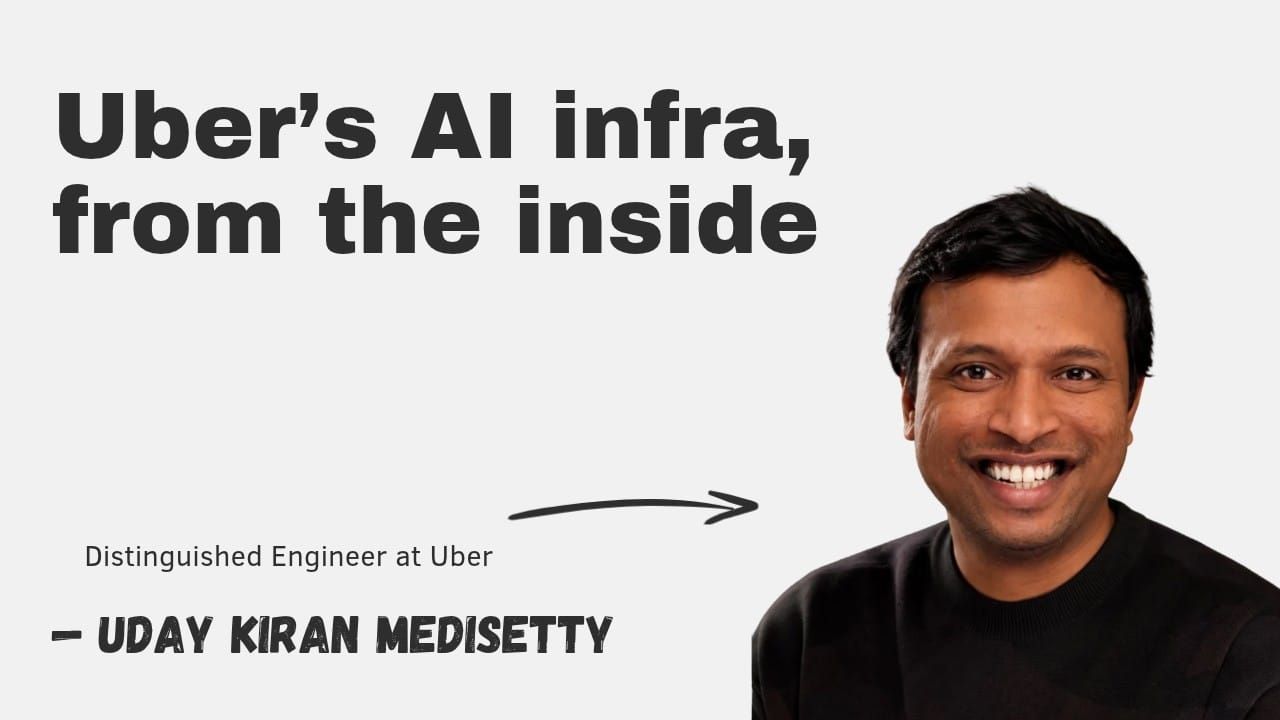
Uday Kiran Medisetty, Uber engineer leading agentic AI work, interviewed by Gergely Orosz (The Pragmatic Engineer)
Uday Kiran Medisetty is one of Uber's longest-tenured engineers and leads much of its work on agentic AI. He joined in May 2015 as roughly the 600th engineer, built the real-time API gateway for the mobile apps, and later worked on fulfillment, Uber for Business, driver onboarding and marketplace pricing. For the past year he has focused on agentic AI for engineers and the rest of the company. Uber runs a single global tech stack in about 4,500 to 5,000 services, with 12 tech sites around the world.
Summary
Uday Kiran Medisetty describes the close to two dozen internal systems Uber built for AI agents, and says most of them sit on infrastructure the company built before AI existed. A model gateway, a tool gateway for MCP, a harness wrapper, a skills repository and a graph of company context are the building blocks that stay the same when models and harnesses change. Agents then use cloud dev boxes, a test environment called Slate, and a traffic capture and replay system to check their own work. About 15% of Uber's production PRs now come from the background coding agent Minion, while a human still reviews every PR. These signals are from an interview that Gergely Orosz did with Uday Kiran Medisetty on The Pragmatic Engineer.